

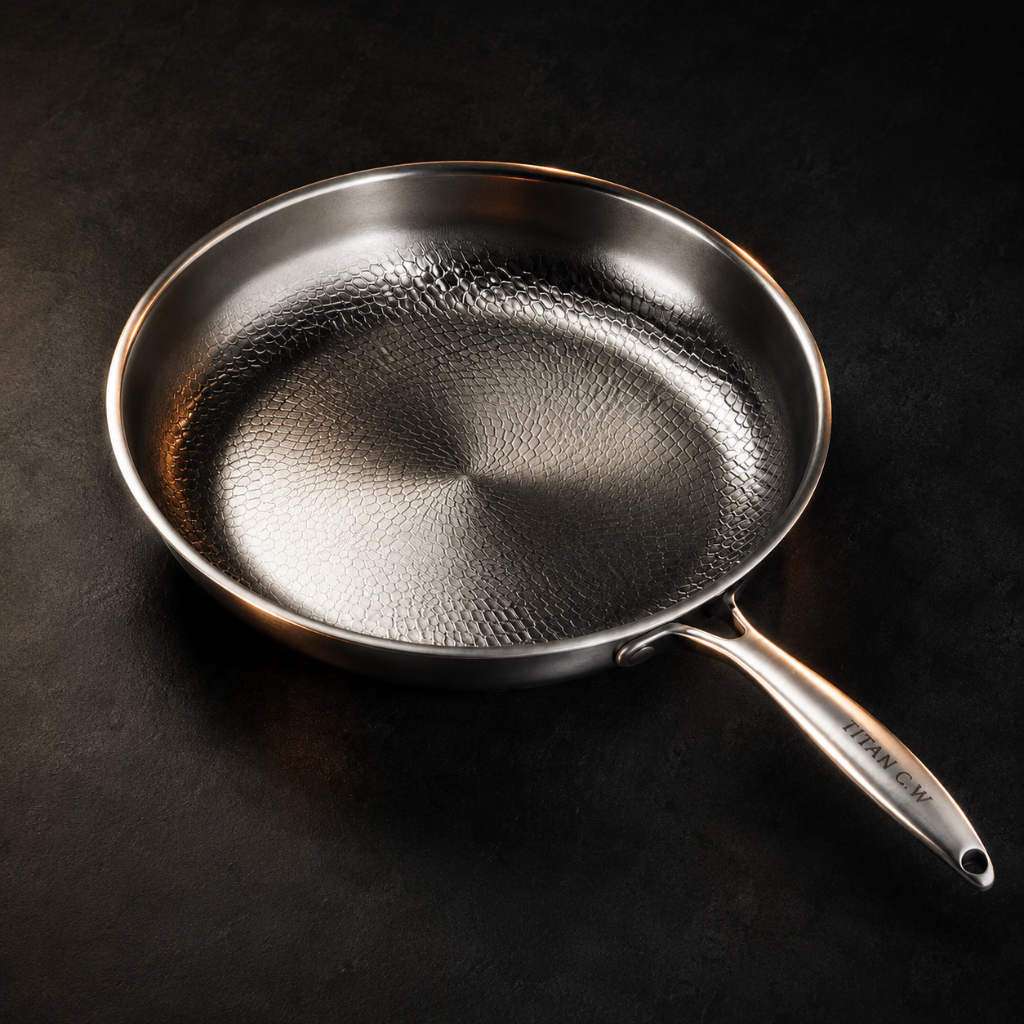
Hand-Hammered Titanium Crepe Pan
A low-profile titanium pan designed for crepes, pancakes, eggs and flatbreads, with shallow edges that make it easier to reach, turn and slide delicate foods.
Size
Current Production Batch
Estimated dispatch: 2 working days – 4 working days
Estimated delivery after dispatch: 3 working days – 7 working days
What's Included
- 1 × Hand-Hammered Titanium Crepe Pan
- 1 × Getting Started With Titanium Guide
- 25-year manufacturing warranty
What to Expect
- —This is not a conventional PTFE-coated non-stick pan. Food release depends on heat, cooking fat and timing.
- —The low-profile sides are designed for easy flipping and serving — not for deep cooking or liquids.
- —Surface colour changes may occur with use — this is normal for uncoated titanium.
New to titanium cookware? Read our getting-started guide.
Product Highlights
No Traditional Non-Stick Coating
The cooking surface is the titanium itself
Induction Compatible
Works on induction cooktops
Oven Safe
Can be used in the oven
Metal-Utensil Friendly
No coating to scratch
Dishwasher Safe
Easy to clean
Hand-Hammered
Textured surface for heat distribution
Built for Better Flipping
A crepe pan is designed around a simple idea: the less wall in your way, the easier it is to reach, turn, and slide food. The low rim and wide, flat cooking surface make it well suited to thin and delicate foods — crepes, pancakes, omelettes, eggs, and flatbreads — where spatula access and easy flipping matter more than containing liquid.
In a standard frying pan, the higher walls can get in the way of a spatula. On a crepe pan, the shallow rim lets you slide a spatula right to the edge, lift, and turn with minimal interference. That makes it easier to cook foods that need to be moved or flipped rather than stirred or tossed.
The wide, flat surface also makes it easier to spread batter. Whether you're making thin French-style crepes, pancakes, or flatbreads, the low profile gives you room to work and room to access what you're cooking.
If you already own the Titan Frying Pan, the crepe pan isn't a replacement — it's a specialist. The frying pan handles everyday searing and general cooking. The crepe pan handles the delicate, low-profile cooking where flipping and access matter most.
Why the Low Profile Matters
The low rim isn't an accident — it's the point. A shallow profile gives you easier spatula access, less side-wall interference, easier flipping, and easier sliding food onto a plate. It also makes spreading batter more convenient, since there's no tall wall in the way of your hand or spatula.
For crepes, pancakes, and flatbreads, this matters. These foods need to be turned rather than stirred, and they need to be accessed rather than contained. The low profile is what makes that possible.
Food Release on Titanium
An uncoated titanium surface doesn't behave like a fresh PTFE-coated non-stick pan. It doesn't rely on a chemical layer to prevent sticking. Instead, food release depends on heat control, cooking technique, and a small amount of fat where needed.
For crepes and pancakes, this means proper preheating, appropriate heat, a light coating of butter or oil, and allowing the first side to set before turning. Batter consistency also matters — a batter that's too thick or too thin can affect how the crepe forms and releases.
Overcrowding the pan or flipping too early can cause sticking. Let the edges set and the surface firm up before you turn. With a bit of practice, the titanium surface provides effective food release for delicate foods.
The First One Is Often the Test
Crepe batter, pan temperature, and fat level sometimes need a small adjustment on the first crepe. This is normal cooking behaviour, not a product defect. The first crepe helps you dial in the right heat and fat level for the rest of the batch.
Getting the Best Results From Your Crepe Pan
A few techniques will help you get the most out of your crepe pan.
Preheat Gently
Start with low-to-medium heat. Titanium conducts heat efficiently, so give the pan a minute or two to warm up before adding batter. Avoid high heat — crepes and pancakes cook better on moderate heat.
Lightly Grease if Needed
A small amount of butter or oil helps with release. The amount depends on your recipe and surface guidance. A thin layer wiped across the surface is often enough.
Add the Right Amount of Batter
Avoid excessive batter. Pour enough to coat the surface thinly — too much batter makes thick, uneven crepes that are harder to turn.
Spread Promptly
For thin crepes, spread the batter while it is still fluid. Tilt the pan or use a spreader to distribute it evenly across the surface before it sets.
Wait for the Edges to Set
Do not flip too early. Let the edges firm up and the surface lose its wet look. The crepe should release from the surface when it is ready to turn.
Turn Gently
Use an appropriate spatula. The low rim makes it easy to slide a spatula right to the edge and lift. Turn gently to avoid tearing.
Adjust Heat Between Batches
Pan temperature may rise during repeated cooking. If crepes start browning too quickly or cooking too fast, reduce the heat slightly between batches.
Allow to Cool Before Cleaning
Let the pan cool before washing. Sudden temperature changes can affect the metal. Wash with warm water and mild detergent. Abrasive sponges are safe — there is no coating to damage.
Pancakes
Use moderate heat and don't overcrowd the pan. Wait for bubbles to form and edges to set before turning. A gentle flip avoids splashing.
Eggs & Omelettes
Proper heat and a small amount of fat help eggs release. Fried eggs, omelettes, and scrambled eggs all work well — but eggs will not slide without fat on an uncoated surface.
Flatbreads
The wide, flat surface is well suited to flatbreads, tortillas, chapati, and similar doughs. The low rim makes it easy to access and turn the bread as it cooks.
What This Pan Is Good For
Crepes
Thin French-style crepes and batter-based dishes
Pancakes
American-style pancakes and drop scones
Eggs & Omelettes
Fried eggs, omelettes, and scrambled eggs
Flatbreads
Tortillas, chapati, and similar flatbreads
Specifications
| Product Type | Crepe Pan |
| Material | Titanium (uncoated) |
| Construction | Hand-hammered titanium |
| Surface | Hand-hammered titanium |
| Handle | Titanium |
| Cooktop Compatibility | Gas, Electric, Ceramic, Induction, Oven |
| Induction Compatible | Yes |
| Oven Compatible | Yes |
| Dishwasher | Yes — dishwasher-safe |
| Metal Utensils | Yes — no coating to scratch |
| Warranty | 25 years against manufacturing defects |
Product Type
Crepe Pan
Material
Titanium (uncoated)
Construction
Hand-hammered titanium
Surface
Hand-hammered titanium
Handle
Titanium
Cooktop Compatibility
Gas, Electric, Ceramic, Induction, Oven
Induction Compatible
Yes
Oven Compatible
Yes
Dishwasher
Yes — dishwasher-safe
Metal Utensils
Yes — no coating to scratch
Warranty
25 years against manufacturing defects
Why Titanium for a Crepe Pan?
For a crepe pan — which sees repeated breakfast cooking, frequent spatula use, and regular cleaning — titanium's characteristics matter. The cooking surface is the titanium itself, with no sprayed coating to wear off, scratch, or degrade over time.
Metal utensils can be used without damaging a coating, and the pan can go in the dishwasher without concern for a coating's integrity. For a pan that gets daily use in a breakfast kitchen, that durability is practical.
Titanium is also relatively light, which helps with a pan you'll be lifting and turning frequently. And it doesn't react with acidic foods — useful if you cook with citrus, tomatoes, or vinegar-based ingredients alongside your breakfast.
Crepe Pan or Frying Pan?
Choose the Crepe Pan when flipping and access matter most. Choose the Frying Pan when you want the most versatile everyday pan.
| Titan Crepe Pan | Titan Frying Pan | |
|---|---|---|
| Best For | Crepes, pancakes, eggs, flatbreads, delicate foods | Everyday frying, searing, vegetables, meat, general cooking |
| Rim Height | Very low — easy spatula access | Higher — more liquid containment |
| Spatula Access | Excellent — minimal wall interference | Good — walls can get in the way |
| Crepes | Excellent — the primary use case | Workable but not ideal |
| Pancakes | Excellent | Good |
| Eggs | Excellent — easy to flip and slide | Good |
| Searing | Limited by low walls | Excellent |
| Vegetables & Meat | Limited — use Sauté Pan or Wok | Good for everyday cooking |
| Liquid Containment | Minimal — not for sauces | Better — higher walls |
| Everyday Versatility | Specialist for low-profile cooking | The best all-rounder |
| Available Sizes | 10 in / 26 cm | 10 in / 26 cm, 12 in / 30 cm |
Titanium vs Coated Crepe Pan
Each has its trade-offs. A coated pan may be easier for immediate low-stick cooking when the coating is new. Titanium may require more technique but does not rely on a sprayed coating.
| Titan Titanium Crepe Pan | Traditional Coated Crepe Pan | |
|---|---|---|
| Cooking Surface | Titanium — no sprayed coating | PTFE or similar non-stick coating |
| Food Release Technique | Heat control, fat, and timing | Coating provides low-stick surface when new |
| Heat Management | Requires technique and preheating | More forgiving when coating is new |
| Metal Utensil Use | Safe — no coating to scratch | Can damage the coating over time |
| Coating Wear | No coating to wear off | Coating can degrade with use and cleaning |
| Care | Abrasive sponges safe; dishwasher-safe | Avoid abrasives to preserve coating |
| Long-Term Surface | Surface remains the same metal | Surface may change as coating wears |
What's Included
- 1 × Hand-Hammered Titanium Crepe Pan
- 1 × Getting Started With Titanium Guide
- 25-year manufacturing warranty
Care for Your Titanium Crepe Pan
Before First Use
Wash the pan with warm water and mild dish soap. Dry thoroughly. Your pan is ready to use — no seasoning is required.
Butter & Oil Residue
Wipe away excess butter or oil with a paper towel while the pan is still warm. Wash with warm water and dish soap to remove any greasy residue.
Batter Residue
Let the pan cool, then soak in warm water. Batter residue usually lifts easily with a sponge. For stubborn spots, use an abrasive sponge — there is no coating to damage.
Stuck Sugar & Caramelised Spots
Sugar and sweet batters can caramelise on a hot pan. Let the pan cool first — do not scrape a hot pan aggressively. Soak in warm water, then use an abrasive sponge or a paste of baking soda and water.
Everyday Cleaning
Hand-wash with warm water and dish soap. Abrasive sponges and steel wool are safe — there is no coating to damage. The pan is also dishwasher-safe.
Dishwasher Guidance
The pan is dishwasher-safe. Hand-washing with warm water and dish soap is also fine and may help preserve the exterior finish over time.
Handle Care
Wipe the handle with a damp cloth. If food collects around the handle attachment, use a soft brush to clean the area. Dry thoroughly.
Underside / Base Care
Keep the base clean. If you use a glass or induction cooktop, wipe away any oil or carbon buildup on the base before use. Avoid dragging the pan across delicate glass surfaces — lift it instead.
Storage & Stacking
The shallow profile makes this pan easy to stack with other cookware. If stacking metal-on-metal, use a soft cloth or pan protector between pans to prevent cosmetic marking. Store flat or hanging — both are fine.
Shipping
Estimated dispatch: 2 working days – 4 working days
Estimated delivery: 3 working days – 7 working days
Free shipping on qualifying orders.
Full detailsCustomer Reviews
NewThis product is new. Be the first to share your experience.


Buying More Than One Piece?
Choose the frying pan, wok, sauté pan, crepe pan and prep pieces that fit the way you cook.
Build Your SetLearn More
Crepe Pan vs Frying Pan: Which One Do You Need?
A crepe pan has a very low rim for easy flipping of crepes, pancakes and flatbreads; a frying pan has higher walls for general cooking, searing and liquid containment. For most cooks buying one pan first, a frying pan is the more versatile choice — but a crepe pan is worth adding if you cook flat foods regularly.
Read GuideHow to Build a Cookware Set That Fits the Way You Cook
Do not build a cookware set by piece count. Build it around what you cook, how many people you cook for, your hob, storage and budget. Start with one essential pan and add pieces based on your cooking style — fewer useful pieces beat many overlapping ones.
Read GuideWhich Titanium Pan Is Right for Me?
The right titanium pan depends on what you cook most. This guide compares the frying pan, wok, sauté pan and crepe pan by cooking style, shape and everyday use to help you choose.
Read GuideFrequently Asked Questions
Make Breakfast Easier to Reach, Turn and Serve
Choose your size and add a low-profile titanium pan to your everyday cookware setup.
$69.99
Current Production Batch