What Is Titanium Cookware?
Quick Answer
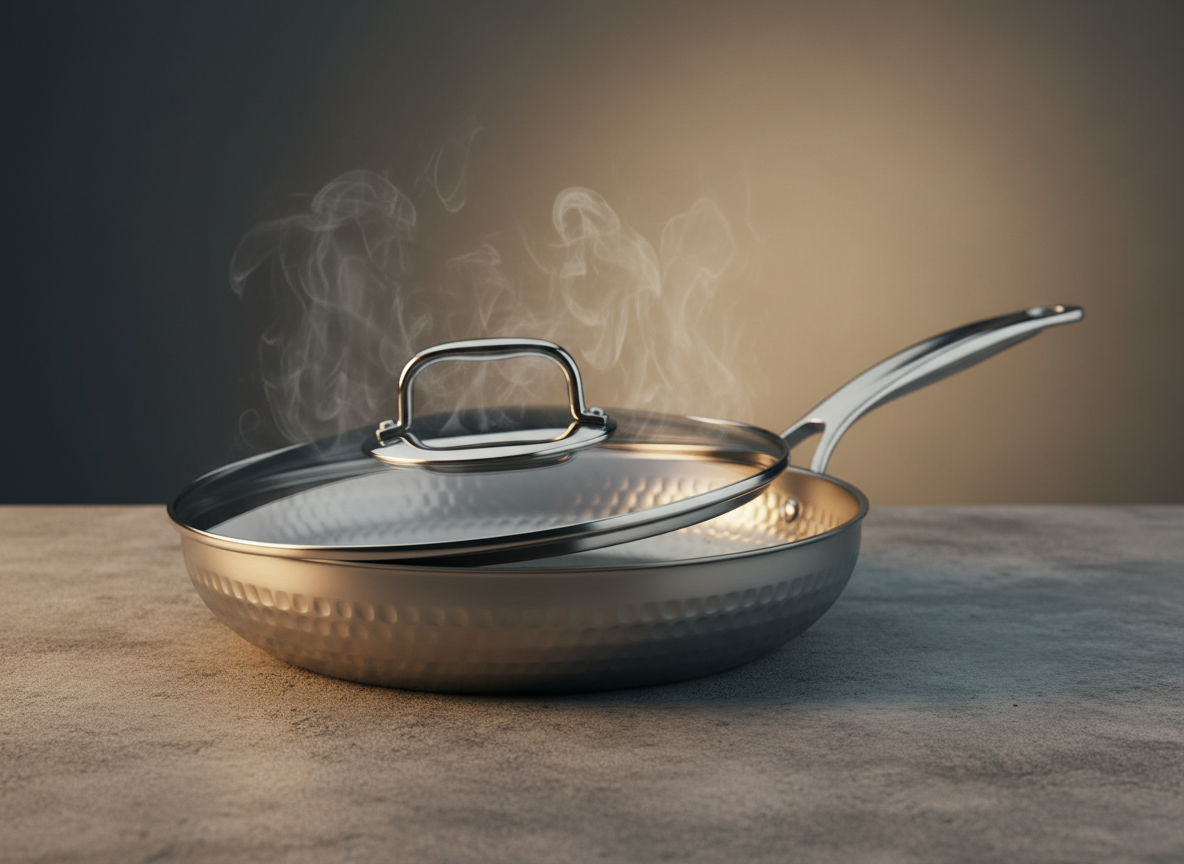
Titanium cookware is a broad term that can describe several different constructions — from solid titanium pans to titanium-reinforced non-stick coatings. Understanding the difference helps you choose the right cookware and assess claims accurately.
What Does Titanium Cookware Mean?
Titanium cookware is a broad term that can describe several different types of cookware — and understanding the difference matters when you are deciding what to buy.
At its simplest, titanium cookware uses titanium in some way in its construction. But that can mean a pan made entirely from titanium, a pan with a titanium cooking surface bonded to other metals, a multi-layer pan that includes titanium as one layer, or even a coated pan that incorporates titanium particles into a non-stick coating.
This guide explains what each type means, how titanium behaves as a cooking material, and what to check before you buy.
Why Titanium Is Used in Cookware
Titanium is used in cookware primarily for its corrosion resistance, surface durability and strength-to-weight ratio. It forms a stable oxide layer naturally when exposed to air, which helps it resist reactions with food.
Unlike coated non-stick cookware, an uncoated titanium cooking surface has no polymer coating to degrade, scratch off or wear away over time. This is one of the main reasons people choose titanium.
Titanium also has a long history of use in demanding technical and medical applications. That context is relevant, but it should not be treated as proof that every titanium cookware product is automatically safe under every cooking condition — safety depends on the specific construction and how the cookware is used.
Not All Titanium Cookware Is the Same
This is the most important thing to understand: the phrase titanium cookware can refer to very different products. A pan described as titanium cookware might be:
Solid titanium — the entire pan body is made from titanium.
Titanium cooking surface — the surface that contacts food is titanium, but the pan body may include other metals for heat distribution.
Titanium-clad or multi-layer — titanium is one layer in a bonded multi-metal construction, often combined with aluminium or stainless steel.
Titanium-reinforced coating — a conventional non-stick coating that incorporates titanium particles for durability.
These constructions behave differently. A solid titanium pan will not cook the same way as a titanium-reinforced coated pan, even though both might be marketed as titanium cookware.
Different Types of Titanium Cookware
Solid titanium cookware is made entirely from titanium. It is lightweight for its strength, highly corrosion-resistant and has no coating to degrade. Because titanium is not the most conductive metal, solid titanium pans may require a slightly different approach to heat management compared to aluminium-core clad pans.
Titanium-surface cookware uses titanium as the cooking surface but may bond it to a core of aluminium or other metals. This approach aims to combine the surface properties of titanium with the heat distribution of more conductive metals.
Titanium-clad or multi-layer cookware bonds titanium to other metals in a layered construction. The titanium layer forms the cooking surface while inner layers — commonly aluminium — provide heat distribution.
Titanium-reinforced coated cookware uses a conventional non-stick coating (often PTFE-based) that incorporates titanium particles. The titanium improves coating durability, but the cooking surface is still a coating — not bare titanium.
Titanium vs Titanium-Reinforced Coatings
The distinction between uncoated titanium and titanium-reinforced coatings is worth understanding clearly.
An uncoated titanium cooking surface is bare metal. There is no polymer layer to scratch, degrade or eventually wear away. Food release depends on cooking technique — preheating, heat management and the use of fat.
A titanium-reinforced coating is a non-stick coating that contains titanium particles. The titanium improves the coating's resistance to wear, but the cooking surface is still a coating. Over time, that coating can degrade just like any other non-stick surface.
If you are choosing titanium cookware specifically to avoid coatings, check whether the product has an uncoated titanium surface or a titanium-reinforced coating. They are not the same thing.
How Titanium Cookware Behaves During Cooking
Uncoated titanium cookware does not behave like a fresh conventional non-stick pan. Food release on an uncoated titanium surface depends on heat management, preheating and the use of cooking fat.
With correct technique — proper preheating, appropriate heat settings and fat where needed — food release can improve significantly. But technique usually matters more than with a coated non-stick surface, especially in the first few uses.
Titanium itself is not the most thermally conductive metal. Solid titanium pans may heat a little differently from aluminium-core pans. This does not mean they cook poorly — it means you may need to adjust your heat settings and preheating habits.
Advantages of Titanium Cookware
The main advantages of uncoated titanium cookware are:
Corrosion resistance — titanium resists reactions with acidic and alkaline foods.
Surface durability — with no coating to degrade, the cooking surface can last for years.
Metal utensil compatibility — there is no coating to scratch, so metal tools are safe to use.
High-heat tolerance — titanium can withstand high cooking temperatures without coating breakdown.
Long-term value — while the upfront cost may be higher, the surface does not need replacing like a coated pan does.
Trade-offs to Consider
Titanium cookware also has real trade-offs:
Learning curve — food release depends on technique, which takes practice if you are used to coated non-stick.
Heat management — you may need to adjust heat settings and preheating habits compared to other cookware.
Heat tint — titanium can develop discolouration (heat tint) at high temperatures. This is a surface oxide effect and does not necessarily affect performance.
Upfront cost — quality titanium cookware typically costs more than basic coated or stainless steel pans.
Construction varies — not every product marketed as titanium cookware is constructed the same way, so you need to check what you are actually buying.
What to Look for When Buying
Before buying titanium cookware, check the following:
Construction — Is it solid titanium, a titanium surface bonded to other metals, or a titanium-reinforced coating? The product description should state this clearly.
Coating status — Does the cooking surface have a non-stick coating, or is it bare titanium? If you want to avoid coatings, confirm the surface is uncoated.
Cooktop compatibility — Is the pan induction-compatible? Not all cookware works on all hobs.
Warranty — A long warranty (10+ years) suggests the manufacturer stands behind the construction.
Care guidance — Check the recommended cleaning methods. If a product claims to be titanium but recommends avoiding metal utensils, it may have a coating.
How Titan Cookware Is Constructed
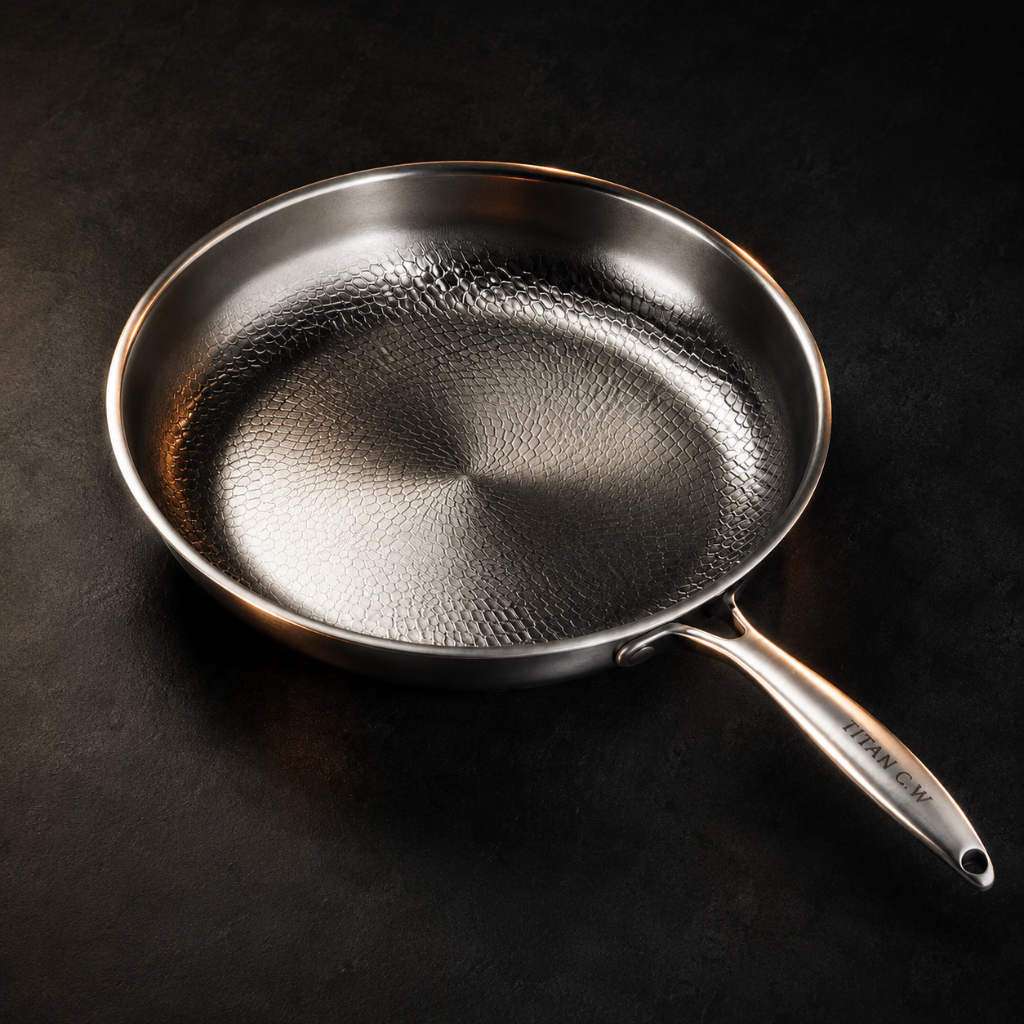
Titan cookware uses an uncoated titanium cooking surface. The frying pan is constructed from hand-hammered solid titanium. The wok, sauté pan and crepe pan use hand-hammered titanium construction.
The cooking surface does not use a conventional PTFE/PFAS non-stick coating. There is no polymer coating to degrade or scratch off.
Because the surface is uncoated, metal utensils are safe to use — there is no coating to scratch. The pans are induction-compatible, oven-safe and dishwasher-safe, and carry a 25-year warranty against manufacturing defects.
Food release on Titan cookware depends on technique — preheating, heat management and the use of fat — not on a coating. This is covered in detail in our guide on how to cook with titanium cookware.
Frequently Asked Questions
Is titanium cookware the same as non-stick cookware?
Not necessarily. Some titanium cookware has a conventional non-stick coating (often with titanium particles for durability), while other titanium cookware is uncoated bare metal. Uncoated titanium does not behave like a fresh coated non-stick pan — food release depends on cooking technique.
Is all titanium cookware solid titanium?
No. The term can refer to solid titanium pans, pans with a titanium surface bonded to other metals, multi-layer constructions that include titanium, or coated pans with titanium-reinforced coatings. Check the product description to understand the construction.
What does titanium-reinforced coating mean?
A titanium-reinforced coating is a conventional non-stick coating (often PTFE-based) that incorporates titanium particles to improve durability. The cooking surface is still a coating — not bare titanium — and it can eventually degrade like any coated surface.
Is titanium cookware lightweight?
Titanium has a high strength-to-weight ratio, so solid titanium pans can be lighter than some comparable constructions. However, weight also depends on pan thickness and design, so it varies by product.
Can titanium cookware be used on induction hobs?
Many titanium pans are induction-compatible, but not all. Check the product specifications — Titan cookware is induction-compatible across the range.
References
- Titanium — Properties and Applications — Royal Society of Chemistry (accessed September 9, 2026)
- Titanium (Ti) — Chemical Properties — Lenntech Water Treatment Solutions (accessed September 9, 2026)
Related Products
Related Guides
Titanium Cookware Pros and Cons
Titanium cookware is extremely durable, lightweight, and free of synthetic coatings. The main drawbacks are price (solid titanium is expensive), a learning curve for food release, and the fact that titanium does not conduct heat as evenly as aluminium or copper. For most cooks, the trade-offs are worth it; for others, they may not be.
Is Titanium Cookware Safe?
Titanium cookware is widely considered safe for cooking. Titanium is biocompatible — it is used in medical implants and dental fixtures — and uncoated titanium pans do not require PFAS, PTFE, or other synthetic coatings that can raise health concerns. The main consideration is buying from a reputable manufacturer, since quality varies.
Titanium vs Stainless Steel Cookware
Stainless steel conducts heat better and is generally less expensive, while titanium is lighter, more durable, and completely free of coatings. Both are inert and safe for acidic foods. The right choice depends on your priorities: even heating and value favour stainless steel; light weight and lifetime durability favour titanium.
Latest Developments
About the Author
Titan Cookwares Editorial Team