Is Titanium Cookware Safe?
Quick Answer
Titanium cookware safety depends on the actual construction, surface, coatings and manufacturer quality — not just the word titanium. Understanding PFAS, PTFE and regulatory context helps you assess claims accurately.
Short Answer
There is no single answer to whether titanium cookware is safe, because the word titanium can describe very different products. Safety depends on the actual construction, the cooking surface, any coatings, the manufacturer's quality, how the cookware is used and its physical condition.
An uncoated titanium cooking surface has no polymer coating to degrade. That is a meaningful difference from coated non-stick cookware. But it does not mean every product marketed as titanium cookware is automatically safe under every condition.
This guide explains what determines cookware safety, what PFAS, PTFE and PFOA actually mean, what regulators say, and how to assess cookware claims for yourself.
What Titanium Cookware Can Mean
As we explain in what is titanium cookware, the term can refer to solid titanium pans, pans with a titanium surface bonded to other metals, multi-layer constructions, or coated pans with titanium-reinforced non-stick coatings.
A titanium-reinforced coating is still a coating — typically PTFE-based — with titanium particles added for durability. If you are evaluating safety and want to avoid coatings, you need to check whether the product has an uncoated titanium surface or a titanium-reinforced coating.
This distinction matters because the safety considerations for an uncoated metal surface are different from those for a polymer coating.
What Makes Cookware Safe?
Cookware safety is not determined by a single material name. It depends on several factors:
Material composition — What metals and materials are used in the construction.
Surface or coating — Whether the cooking surface is bare metal or has a coating, and what that coating is made of.
Manufacturer quality — Whether the product is made to a consistent standard with appropriate quality control.
Intended use — Whether the cookware is used within its designed temperature range and cooking methods.
Physical condition — Whether the cookware is in good condition, without damage or degradation.
Regulatory compliance — Whether the materials and coatings comply with relevant food-contact regulations.
Care and use — Whether the cookware is cleaned and maintained according to manufacturer guidance.
Reducing cookware safety to a single material name — titanium, stainless steel, ceramic or anything else — oversimplifies a question that depends on all of these factors.
Titanium as a Material
Titanium is a metal with several properties that are relevant to cookware:
Corrosion resistance — Titanium resists corrosion from acidic and alkaline foods better than many metals. This is because it forms a stable oxide layer naturally when exposed to air.
Biocompatibility — Titanium has a long history of use in demanding technical and medical applications, including implants. This context is relevant, but it should not be treated as proof that every titanium cookware product is automatically safe under every cooking condition. Implant-grade titanium in a medical context and a titanium cooking surface in a kitchen are different applications with different considerations.
High melting point — Titanium has a high melting point (approximately 1668°C), well above normal cooking temperatures.
These are general material properties. How they apply to a specific cookware product depends on the construction, surface and how the product is used.
Titanium Cookware Coatings vs Bare Surfaces
The safety considerations differ between coated and uncoated titanium cookware.
Uncoated titanium cookware has a bare metal cooking surface. There is no polymer coating to degrade, scratch off or migrate into food. The main considerations are normal cookware safety: using the pan within its temperature range, maintaining it properly and replacing it if it becomes physically damaged.
Titanium-reinforced coated cookware has a conventional non-stick coating (often PTFE-based) with titanium particles added. The safety considerations for the coating are the same as for any coated non-stick pan: the coating should not be overheated, scratched or allowed to degrade.
If you are choosing titanium cookware specifically to avoid coatings, confirm that the cooking surface is uncoated titanium, not a titanium-reinforced coating.
PFAS, PTFE and PFOA Explained
These terms are often used interchangeably in marketing, but they refer to different things:
PFAS (per- and polyfluoroalkyl substances) is a very broad class of fluorinated chemicals. There are thousands of PFAS compounds with different properties, uses and exposure profiles. PFAS is a family, not a single substance.
PFOA (perfluorooctanoic acid) is one specific PFAS compound. It was previously used in the manufacturing of some non-stick coatings but has been largely phased out by major manufacturers.
PTFE (polytetrafluoroethylene) is a fluoropolymer — the material most commonly associated with traditional non-stick coatings. PTFE is distinct from PFOA, although PFOA was historically used in PTFE manufacturing.
It is not accurate to treat PFAS, PTFE and PFOA as identical. They are related but distinct, and the safety considerations for each differ.
What Regulators Say
The U.S. Food and Drug Administration (FDA) regulates food contact substances, including materials used in cookware. The FDA reports that authorised polymerised PFAS coatings used in certain cookware applications are manufactured in a way intended to tightly bind the coating, and that the FDA has found negligible amounts of PFAS capable of migrating to food from these authorised uses.
This means it would be inaccurate to claim that all non-stick cookware is dangerous or that all PFAS coatings leach harmful levels into food. The FDA's position is more nuanced than that.
At the same time, the U.S. Environmental Protection Agency (EPA) notes that PFAS is a large chemical family and that different PFAS compounds have different properties, uses and environmental and health profiles. Concerns vary by compound and by exposure pathway.
Neither agency makes a blanket statement that all PFAS is dangerous in all contexts, nor that all PFAS is harmless. The regulatory position is compound-specific and context-specific.
If you want to avoid PFAS coatings entirely — regardless of the regulatory position on authorised uses — choosing uncoated cookware is a clear way to do so.
Titan Cookware Construction
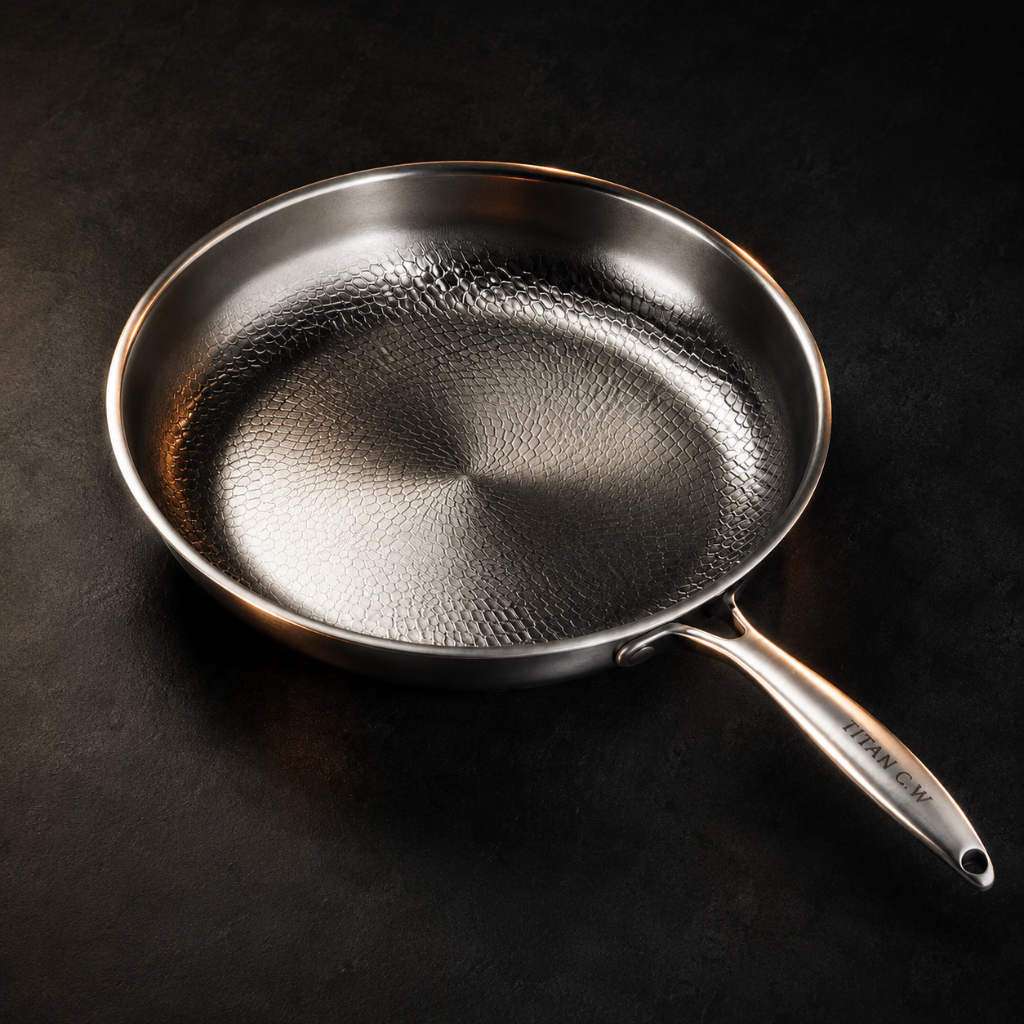
The verified Titan cooking surface does not use a conventional PTFE/PFAS non-stick coating. The cooking surface is uncoated titanium.
This means there is no polymer coating to degrade, scratch off or migrate into food. The surface is bare titanium metal.
We state this as a product-specific fact based on the verified construction. We do not extend it into broader claims that the entire product contains zero fluorinated substances in every component, or that titanium cookware eliminates all chemical exposure from all cooking. Those claims would go beyond what the product data supports.
For more detail on the construction, see what is titanium cookware.
Safe-Use Practices
Regardless of material, general cookware safety practices apply:
Use cookware within its designed temperature range. Titan cookware is rated to 1000°F / 540°C, which covers all normal cooking methods.
Avoid thermal shock — do not move a hot pan directly to cold water, as rapid temperature changes can stress any metal.
Keep cookware in good condition. If a pan becomes warped, cracked or physically damaged, replace it.
Follow manufacturer care guidance. Titan cookware is dishwasher-safe and abrasive sponges are safe because there is no coating to damage.
Use appropriate ventilation when cooking at high temperatures, regardless of cookware type.
How to Assess Cookware Claims
When evaluating safety claims from any cookware brand — including Titan — consider the following:
Is the claim specific to the product, or is it a general statement about a material? General material properties do not automatically apply to every product made from that material.
Does the claim distinguish between the cooking surface and the overall construction? A coating-free cooking surface does not mean the entire product is made from one material.
Are safety claims supported by references to regulators, material science or manufacturer data — or are they based on vague language and fear appeals?
Does the claim avoid absolute language like completely non-toxic, nothing to leach or 100% safe? Absolute safety claims are rarely scientifically supportable.
A credible brand should be able to tell you what its cooking surface is made of, what coatings (if any) are present, and what the construction involves. If a brand cannot or will not answer those questions, that is worth noting.
Frequently Asked Questions
Is titanium safe for cooking?
Titanium has properties that are relevant to cookware safety, including corrosion resistance and a stable surface oxide layer. An uncoated titanium cooking surface has no polymer coating to degrade. However, safety depends on the specific construction, surface and use — not just the word titanium.
Does titanium cookware contain PFAS?
Uncoated titanium cookware does not have a PFAS coating because it has no coating at all — the cooking surface is bare titanium. However, some products marketed as titanium cookware use titanium-reinforced non-stick coatings, which may be PTFE-based. Check the product description to confirm.
Is all titanium cookware uncoated?
No. Some titanium cookware is uncoated bare titanium, while other products use titanium-reinforced non-stick coatings. These are different constructions with different safety considerations. Check whether the cooking surface is bare metal or coated.
Is titanium reactive with food?
Titanium is known for its corrosion resistance and low reactivity with food, which is one reason it is used in cookware. It forms a stable oxide layer that helps resist reactions with acidic and alkaline foods.
What should I check before buying titanium cookware?
Check the construction (solid titanium, titanium surface, or titanium-reinforced coating), whether the cooking surface is coated or uncoated, cooktop compatibility, warranty and care guidance. A credible brand should clearly state what the cooking surface is made of.
Does the FDA say non-stick cookware is dangerous?
No. The FDA reports that authorised polymerised PFAS coatings used in cookware are manufactured to tightly bind the coating, with negligible PFAS migration to food from these authorised uses. The regulatory position is nuanced, not a blanket warning.
References
- PFAS Chemicals in Food — U.S. Food and Drug Administration (FDA) (accessed September 9, 2026)
- Per- and Polyfluoroalkyl Substances (PFAS) — U.S. Environmental Protection Agency (EPA) (accessed September 9, 2026)
- Food Contact Substances (FCS) — U.S. Food and Drug Administration (FDA) (accessed September 9, 2026)
- Titanium — Properties and Applications — Royal Society of Chemistry (accessed September 9, 2026)
Last fact-checked September 9, 2026
Related Products
Related Guides
About the Author
Titan Cookwares Editorial Team